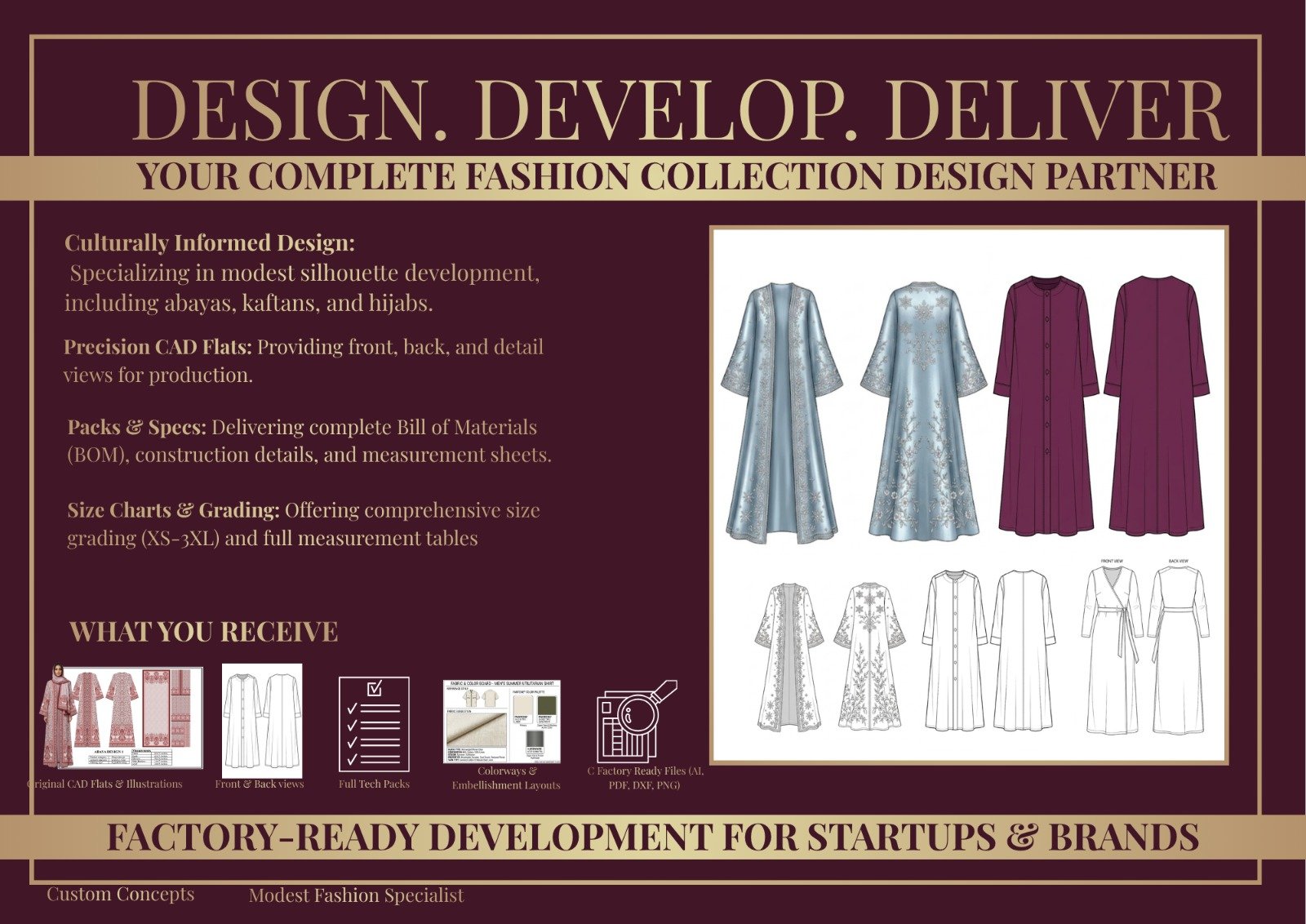
There is no responsible universal price for manufacturing an abaya. Cost depends on the exact product, development route, fabric and consumption, lining, construction, embellishment, colours, sizes, quantity, labels, packaging, supplier responsibilities and delivery basis. A useful answer therefore explains how a project is costed and how to compare quotations, rather than publishing a headline figure detached from scope.
Decision comparison
Four layers of an abaya cost model
Keep one-time, per-unit, order-level and delivery costs visible so quotations can be normalised to the same project scope.
| Cost layer | Typical components | Decision to confirm |
|---|---|---|
| Development | Design files, technical work, pattern route, samples and artwork setup | What is one-time, revised or reusable |
| Garment unit | Main fabric, lining, trims, cutting, sewing, embellishment and finishing | Approved quality and operation assumptions |
| Order level | Material balances, setup, testing, inspection, labels, packaging and export packing | How each charge is allocated or excluded |
| Delivery and landed | Freight, insurance where applicable, customs, duties, taxes and final delivery | Delivery basis, destination and responsible party |
1. Define the product before asking for a price
A request for ‘the cost of one abaya’ does not define a manufacturable product. A straight unlined everyday style, a fully lined open abaya and an embellished occasion piece can require different fabric quantities, operations, suppliers, approval stages and handling. Even two visually similar garments can differ in internal construction and finishing.
Start with a controlled brief: garment type, silhouette, length and size range, fabric and lining direction, colourways, closures, pockets, artwork or embellishment, branding, packaging, quantity by style and colour, destination and target timing. Mark decisions that remain proposed so the quotation can state assumptions instead of hiding them.
- Garment and construction route
- Fabric, lining and colour direction
- Sizes and quantity matrix
- Artwork, trims and branding
- Packaging and destination
- Open decisions requiring assumptions
2. Separate development cost from production cost
Development can include original design work, technical flats, a tech pack, pattern or sample preparation within the agreed route, material sourcing, artwork setup and revision rounds. These activities happen before a production line can repeat an approved style, so combining them invisibly into one unit figure makes quantities and reorders difficult to compare.
Ask which charges are one-time, which repeat after a design change and which may be reused for an approved reorder. Confirm ownership and handover of the files included in scope. Zameett does not advertise sewing patterns or grading as standalone services; any relevant technical, sampling or production responsibility must be stated in the project proposal before payment.
3. Calculate fabric and lining from the approved product
Material cost depends on price per unit of purchase and the approved consumption needed for the garment. Consumption changes with usable width, garment length, hem sweep, sleeve shape, lining coverage, size range, shrinkage or relaxation allowance, matching requirements and cutting efficiency. Directional surfaces or prints can limit how pieces are placed.
Identify the exact approved fabric and colour rather than costing from a category name such as nida or crepe. Record the consumption basis, units, width, size or marker assumption, expected allowance and treatment of leftover material. A cheaper price per metre does not guarantee a cheaper garment when width, quality, defect rate or lining need changes.
4. Price construction by operations and handling
Cut-and-sew cost reflects the operations and control needed to make the approved garment. Panels, yokes, pleats, gathers, curved hems, pockets, facings, linings, concealed openings, cuffs, bindings, topstitching and layered sleeves can add cutting, sewing, pressing and inspection work even when the exterior looks restrained.
Share front, back and detail flats plus construction notes, measurements and sample status. Ask whether quotation assumptions include cutting, sewing, thread, interfacing, pressing, thread trimming, measurement checks and standard finishing. If a supplier changes a seam, finish or internal component to reach a target price, document and sample the revised product before approval.
5. Cost embellishment from controlled artwork
Machine embroidery can depend on digitising, motif dimensions, stitch structure, coverage, thread changes, backing, hoop access and placement count. Hand beadwork, sequins, appliqué and mixed techniques depend on component quality, quantity, attachment method, labour, handling and inspection. A reference photograph labelled only ‘similar beading’ is not a cost specification.
Provide the artwork version, physical dimensions, colours, technique, backing, components, orientation and placement from stable garment points. Use an embellished panel or relevant sample to confirm density, puckering, weight, drape and finish before finalising the production assumption. A design change after sampling can affect material, labour, rejection risk, MOQ and schedule.
- Artwork dimensions and version
- Machine, hand or mixed technique
- Thread or component references
- Placement count and size rules
- Approved panel or garment sample
- Inspection and repair responsibility
6. Add trims, labels and packaging explicitly
Closures, zips, snaps, buttons, interfacing, elastic, thread, main labels, size labels, care labels, hangtags, stickers, bags, tissue, inserts and cartons can carry separate specifications, setup costs and supplier minimums. Their purchase quantity may be larger than the garment quantity or shared across several styles.
Request a component-level list that identifies what the unit price contains and what is supplied or paid separately. Record the purchased quantity, quantity allocated to the order and treatment of any balance. Confirm packaging configuration and export-packing assumptions because a branded presentation route can differ materially from simple protective packing.
7. Understand quantity without relying on a headline MOQ
Order quantity affects material purchasing, cutting efficiency, line setup, component buying and the way fixed activities are allocated. However, MOQ is not one universal number. Minimums may apply to the order, style, fabric, colour, motif, label, packaging component or specialist supplier and can overlap.
Convert the proposed order into a style-colour-size matrix before requesting price breaks. Ask which constraint changes at each quantity and keep product specifications identical between tiers. A lower unit price at a larger volume is not automatically a better business decision if it increases total cash exposure, inventory risk or the number of unproven combinations.
- Minimum basis for every input
- Units per style, colour and size
- Material and component balances
- Price-break driver
- Total order value and payment stages
- Reorder assumptions
8. Keep sampling, revisions and approvals visible
A sample fee can represent materials, pattern or technical preparation within the supplier's route, cutting, sewing, embellishment, courier and the time needed for a non-repeating garment. Clarify what the sample is meant to prove, which materials it uses, how many revisions are included and what happens when the brief changes.
Do not assume an accepted appearance approves fabric, graded sizes, labels, packaging or bulk workmanship that the sample did not represent. Link every approved sample to the current specification and material references. Ask whether a later change requires a new sample, revised quotation or schedule update before authorising the affected work.
9. Distinguish ex-factory, order and landed cost
A garment unit price may stop at the supplier's facility or another named delivery point. It may exclude inspection, export documents, outer cartons, freight, insurance, customs handling, duties, taxes, destination charges, final delivery and fulfilment preparation. Without the delivery basis and destination, two prices may not cover the same commercial journey.
Ask each supplier to state the named delivery basis, included services, packaging configuration, shipment assumptions, currency, quote validity, payment stages and responsibility for costs outside the quotation. Brands should obtain current freight, customs and tax guidance from the appropriate providers for the actual destination rather than relying on a generic percentage.
10. Compare quotations on normalised scope
Build a comparison sheet with one row for every required cost or responsibility. Place supplier quotations beside the same approved garment brief, quantity matrix, material quality, sample stage, delivery basis and destination. Mark included, excluded, estimated, provisional and buyer-supplied items rather than treating an empty cell as zero.
Investigate large differences by tracing them to fabric, consumption, construction, embellishment, setup, MOQ, quality checks, packaging, delivery or an unconfirmed assumption. The strongest quotation is not necessarily the lowest number; it is the one whose product, responsibilities, approval gates and commercial conditions can be understood and verified before payment.
- Same design and current specification
- Same fabric, trims and artwork quality
- Same style-colour-size quantity matrix
- One-time and repeatable charges separated
- Inclusions, exclusions and assumptions marked
- Delivery basis and destination aligned
11. Prepare a quote-ready Zameett brief
Zameett provides fashion design and technical-development services across apparel categories, with sampling and manufacturing specialisation mainly in modest wear and abayas. Manufacturing MOQ and quotation remain project-specific because garment, fabric, colour, embellishment, trims, labels, packaging, quantity, size mix, destination and selected suppliers shape the route.
Share the garment category, style count, available design or technical files, proposed quantities by style and colour, size direction, fabric and lining needs, artwork, branding, packaging, destination and target timing. The proposal confirms deliverables, revisions, fees, assumptions, exclusions, supplier responsibilities, approval stages, project-specific timeline and payment scope before work begins.
- Current design or technical files
- Quantity and size-colour matrix
- Material and embellishment direction
- Labels and packaging requirements
- Destination and delivery assumptions
- Target timing and open decisions
Frequently Asked Questions
Questions about this topic
How much does it cost to manufacture an abaya?
There is no reliable universal figure. Cost depends on the exact design, development route, fabric and consumption, lining, construction, embellishment, colour and size mix, quantity, branding, packaging, supplier responsibilities and delivery basis.
What usually affects abaya manufacturing cost most?
The main driver varies by product. Fabric and consumption may dominate a plain style, while complex construction or substantial embellishment can become more important. A line-by-line quotation reveals the actual driver for the approved garment.
Why does the unit price change with quantity?
Material purchasing, cutting, line setup, component minimums and fixed activities are allocated differently at each quantity. Ask what changes at every price break and compare total cash exposure as well as unit price.
What should an abaya manufacturing quotation include?
It should identify the product and revision, materials, construction, embellishment, trims, labels, packaging, quantity matrix, samples or setup, quality or inspection responsibilities, included and excluded services, delivery basis, payment scope and assumptions.
What is the difference between ex-factory and landed cost?
Ex-factory cost generally ends at the supplier's facility under the stated quotation terms. Landed cost can add packing, inspection, freight, insurance where applicable, customs, duties, taxes and destination delivery. The exact responsibility must be confirmed for the shipment.
Apply This to Your Collection
Develop your next product with a clear scope.
Share your category, style count, available files, quantity and target date. Zameett will recommend the most suitable design, technical-development, sampling or reviewed production route.